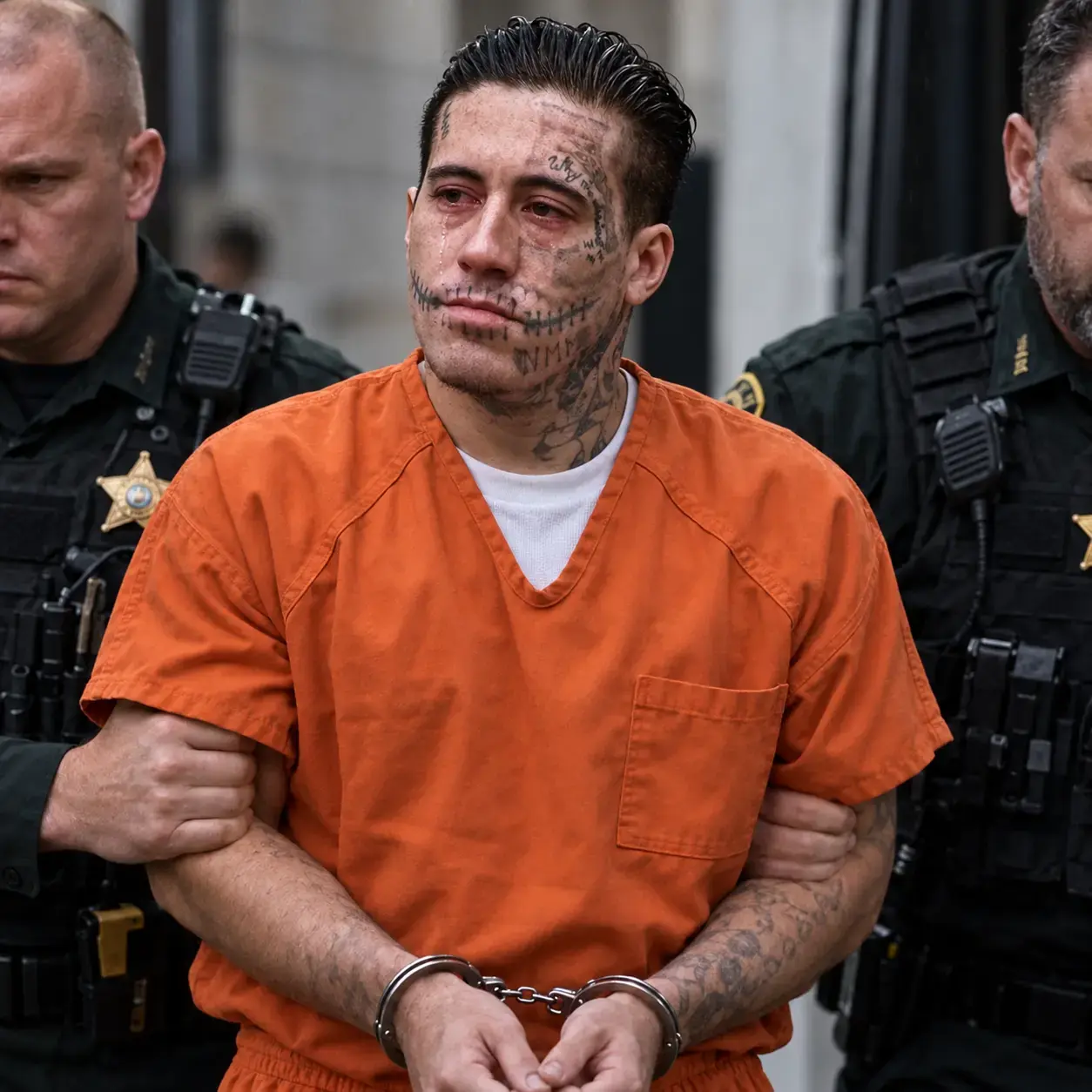
💥 LATEST BOMBSHELL: Wade Wilson’s Supreme Court Strategy Stuns Observers — Why His Lawyers Cut Their Florida Arguments Short and Set Their Sights on the Highest Court in America
U.S. CRIME & JUSTICE | OCTOBER 18, 2026


TALLAHASSEE, FLORIDA — A courtroom appearance lasting only minutes has become one of the most revealing moments in Wade Wilson's fight against his death sentences. What many expected to be a lengthy legal confrontation instead ended almost as soon as it began, leaving observers with one extraordinary question: Why would a defense attorney abandon an opportunity to argue before Florida's highest court?
The answer lies in a legal strategy that could carry Wilson's challenge beyond Florida and into the jurisdiction of the United States Supreme Court.
On February 5, 2026, attorney Michael Ufferman appeared before the Florida Supreme Court to challenge the death sentences imposed on Wilson for the 2019 murders of Kristine Melton, 35, and Diane Ruiz, 43.
Instead of delivering an extended argument, Ufferman spoke for approximately 90 seconds.
The entire proceeding lasted roughly three minutes.
It was not an admission of guilt, a withdrawal of every appeal, or an announcement that Wilson's legal battle had ended.
It was a calculated acknowledgment that the Florida Supreme Court had already rejected the central constitutional arguments in other cases.
WBBH
+1
The 90-Second Courtroom Moment That Changed the Conversation
The atmosphere inside the Florida Supreme Court was unusual.
Attorneys had prepared for a significant capital punishment appeal, but Ufferman quickly explained that recent decisions had left little room for meaningful debate.
The court had already addressed substantially similar challenges to Florida's death penalty law.
Repeating those arguments before the same justices would be unlikely to change the result.
Ufferman told the court that the logical next step would be seeking consideration by the U.S. Supreme Court.
He described the futility of continuing the same argument as beating his head against a brick wall.
The state's attorney, Rick Buchwalter, likewise offered no lengthy presentation and asked the justices to affirm the lower court's decision.
The brevity of the exchange even prompted a lighthearted reaction from the bench.
But behind that moment was a profoundly serious constitutional dispute involving the rules governing capital punishment.
WBBH
+1
The Legal Issue That Could Determine Wilson's Fate
The central dispute concerns a major change in Florida's death penalty law.
When Melton and Ruiz were murdered in October 2019, Florida required a unanimous jury recommendation before a death sentence could be imposed.
That changed in 2023.
Under the revised law, a jury can recommend death with the support of at least eight of its twelve members.
Wilson was convicted in 2024, after the new law took effect.
His jury recommended death by votes of 9–3 for Melton's murder and 10–2 for Ruiz's murder.
Neither recommendation was unanimous.
Nevertheless, both satisfied the requirements of Florida's revised statute, and the trial judge imposed two death sentences in August 2024.
Wilson's lawyers challenged the application of the newer law to crimes committed before its enactment.
Their argument raised constitutional questions about retroactive changes to criminal punishment, including the prohibition on ex post facto laws.
The defense contended that applying the less demanding jury-vote requirement to Wilson's case violated protections under federal and state law.
Florida's courts, however, had already rejected similar arguments in other capital cases.
Court TV
+1
Why the Defense Chose Not to Fight a Battle It Expected to Lose
The most important detail is that Ufferman was not simply giving up.
His decision reflected a distinction between arguing a legal issue and preserving that issue for review by a higher court.
In December 2025, the Florida Supreme Court issued decisions in Jackson v. State and Hunt v. State that upheld the state's revised capital sentencing framework against relevant challenges.
Those decisions became major obstacles for Wilson's defense.
By February 2026, Ufferman recognized that the justices were unlikely to reverse themselves on substantially the same constitutional questions only weeks after deciding them.
Continuing to repeat his written arguments would therefore have served little practical purpose.
Instead, he made clear that the defense intended to preserve its objections and pursue federal review.
This is a familiar appellate strategy.
When a state supreme court has established binding precedent against a defendant's position, lawyers may focus on ensuring that federal constitutional claims remain properly preserved rather than spending valuable courtroom time repeating arguments already rejected.
But there is an important limitation: preserving an argument does not guarantee that the U.S. Supreme Court will agree to hear it.
Why the U.S. Supreme Court Matters
The United States Supreme Court occupies a fundamentally different position from Florida's highest court.
Although the Florida Supreme Court has final authority over many questions of state law, the U.S. Supreme Court can review federal constitutional issues arising from state criminal proceedings.
That distinction is central to Wilson's strategy.
His lawyers want federal justices to consider whether Florida's application of its 2023 capital sentencing law to earlier crimes violates constitutional protections.
The defense could seek review through a petition for a writ of certiorari.
If the petition is filed, the U.S. Supreme Court would first decide whether to accept the case.
Most petitions are denied.
A denial would not necessarily mean the justices agree with every aspect of the lower court's reasoning. It would simply mean that the Court declined to review the case.
If review were granted, the justices could examine the relevant constitutional questions and potentially issue a ruling affecting Wilson's sentences.
A favorable ruling might require additional proceedings or resentencing. It would not automatically overturn his murder convictions or establish his innocence.
As of the information verified for this article, Ufferman's intention to seek U.S. Supreme Court review is documented, but a completed petition and a decision accepting the case have not been independently established.
Court TV
+1
The Two Women at the Center of the Case
Beyond the courtroom arguments and constitutional disputes are two victims whose lives were taken on October 7, 2019.
Kristine Melton was 35 years old.
Diane Ruiz was 43.
Their murders shocked the Cape Coral and Fort Myers communities and became the foundation of one of Florida's most widely publicized capital cases.
Wilson was convicted of first-degree murder in June 2024.
The court later imposed two death sentences.
For the victims' families, the continuing appeals mean that the legal consequences of those crimes remain subject to review years after the killings.
The defense's constitutional arguments do not erase the jury's findings or diminish the seriousness of the crimes.
They concern whether the state followed constitutionally permissible procedures when imposing the ultimate criminal punishment.
That distinction is essential to understanding the case.
People.com
+1
Could This Case Affect Other Florida Death Row Prisoners?
The implications could extend beyond Wilson.
Florida's 2023 law lowered the number of jurors required to recommend a death sentence from twelve to eight.
Because that change affects capital sentencing, constitutional challenges to its application can raise questions relevant to other defendants sentenced under the revised framework.
A significant U.S. Supreme Court ruling on retroactivity or capital jury requirements could influence how courts evaluate comparable cases.
But such an outcome remains hypothetical.
The justices would need to accept an appropriate case, consider the constitutional issues, and issue a decision with broader legal consequences.
Even a ruling favorable to Wilson might be narrowly written and limited to specific circumstances.
It would be inaccurate to claim that his appeal is certain to invalidate Florida's death penalty law or halt executions statewide.
The potential significance is real, but the outcome is uncertain.
What Happens If the Supreme Court Refuses to Hear the Case?
A refusal by the U.S. Supreme Court to grant review would be a serious setback for the particular constitutional challenge raised in a certiorari petition.
However, it would not necessarily mean that every possible legal avenue had been exhausted.
Capital cases can involve multiple stages of review, including direct appeals, state post-conviction proceedings, and federal habeas corpus litigation.
Different proceedings may address different issues.
For example, direct appeals commonly focus on alleged errors in the trial record, while post-conviction litigation may involve claims that require evidence beyond that record.
Federal habeas review is subject to strict procedural requirements, filing deadlines, and limitations on the claims courts may consider.
These protections exist because a death sentence is irreversible once carried out.
At the same time, appellate courts are not simply conducting a second jury trial.
They review legal and constitutional questions according to specific standards.
For Wilson, the path forward depends on actual court orders, future filings, and the decisions of the courts with jurisdiction over his claims.
Why Three Minutes in Court Became Such a Major Story
The February hearing attracted attention partly because of its extraordinary brevity.
People often imagine high-stakes appeals as hours of intense questioning, dramatic exchanges, and attorneys fighting over every legal detail.
Wilson's hearing looked very different.
The defense acknowledged unfavorable precedent.
The state requested affirmance.
The proceedings ended quickly.
Yet that unusual simplicity revealed something important about the appellate process.
A lawyer can recognize that a particular court is unlikely to provide relief while continuing to maintain that a higher court should reconsider the legal issue.
The decision not to repeat arguments orally was therefore not necessarily a sign that the defense believed its constitutional claims lacked merit.
It reflected the practical reality that Florida's highest court had already expressed its position.
For Ufferman, the more promising procedural objective was to preserve the opportunity to seek a different answer from federal justices.
Whether that approach ultimately succeeds remains an open question.
A Case That Raises Questions About Justice and Constitutional Protection
The controversy surrounding Wilson's sentencing reaches beyond one defendant.
It raises a fundamental question about the relationship between changes in criminal law and offenses committed before those changes took effect.
The U.S. Constitution prohibits ex post facto laws, but determining whether a particular statutory change violates that prohibition can involve complicated distinctions between substantive punishment and procedural rules.
Wilson's defense maintains that Florida's revised death recommendation threshold should not have been applied to his case.
The state has defended the validity of the revised sentencing system.
Those competing positions reflect a broader legal debate over the constitutional requirements governing capital punishment.
For supporters of strict death penalty enforcement, the jury's recommendations and the trial judge's sentences represent the outcome of a lawful prosecution for exceptionally serious crimes.
For critics of non-unanimous death recommendations, the case raises concerns about whether the most severe punishment should be permitted when jurors disagree over the appropriate sentence.
The U.S. Supreme Court has the authority to resolve federal constitutional questions, but it is not obligated to accept every case presenting them.
The Next Chapter Remains Uncertain
Wilson's case continues to attract public attention because it combines horrific crimes, severe punishment, and a consequential legal dispute.
The most revealing moment of the February 2026 hearing was not a dramatic confrontation between attorneys.
It was the defense's recognition that the battle over Florida's capital sentencing statute had reached a point where repeating the same arguments before the same court offered little practical advantage.
That explains the decision to limit oral argument.
Ufferman was looking beyond Tallahassee.
He wanted the federal constitutional issues preserved for potential consideration in Washington.
Whether the United States Supreme Court will ultimately address those issues remains to be seen.
The central question is no longer simply why Wade Wilson's lawyers spoke for only 90 seconds. It is whether the constitutional arguments they preserved will ever receive a full hearing before the nation's highest court.
For Wilson, the answer could have profound consequences for his death sentences.
For Florida, a future ruling could clarify the constitutional limits of its capital sentencing framework.
And for the families of Kristine Melton and Diane Ruiz, the continuing legal proceedings represent another chapter in a case whose consequences have endured for years.
The courtroom arguments may have lasted only minutes, but the legal questions they raised are far from simple.
Reporting basis: Court TV's February 5, 2026 hearing report, Gulf Coast News Now's coverage of the same proceeding, and the Florida Supreme Court's archived case materials, case SC2024-1345.